
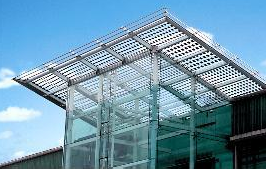
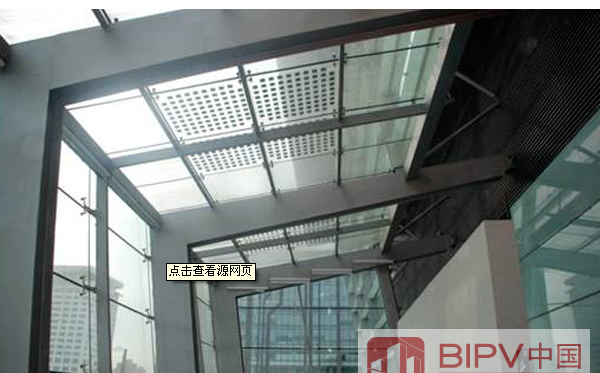
BIPV-building integrated photovataic, is an integrated technology of solar power modules and buildings (curtain walls). Integrated photovoltaic products can be widely used in building shading systems, building curtain walls, photovoltaic roofs, photovoltaic doors and windows, etc., on the basis of meeting conventional lighting and architectural aesthetics, while providing clean and environmentally friendly electricity.
Photovoltaic power generation system
There are two forms of photovoltaic power generation systems, one is an independent power generation system; the other is a grid-connected power generation system, which directly inputs electrical energy into the public grid. Among these two forms, grid-connected power generation systems are the main form of solar photovoltaic applications and the development direction of most countries in the world.
BIPV's glass module structure
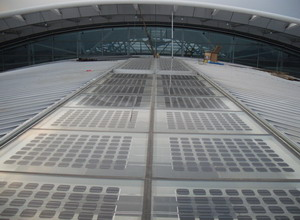
BIPV can be divided into two categories: one is the combination of photovoltaic arrays and buildings. The buildings serve as the carrier of the photovoltaic arrays and play a supporting role. The other is the integration of photovoltaic arrays and buildings. A variety of building materials have appeared, such as photovoltaic curtain walls and photovoltaic roofs. Regardless of whether it is a crystalline silicon cell module or a thin-film silicon cell module, a reasonable combination of cells and glass sheets is the prerequisite and basis for BIPV. At present, the typical BIPV photovoltaic glass module structure is mainly: a combination of tempered glass sandwich structure (double glass sandwich structure) and hollow structure.
BIPV security performance
The combination of photovoltaic modules and buildings will involve structural safety performance:
a) As the structural safety of the curtain wall, it needs to meet three characteristics: wind pressure deformation performance, rainwater permeability,
Air permeability;
b) When the BIPV photovoltaic module is damaged and affected, what kind of impact will the normal operation of the cell have?
c) The safety of the connection method of the fixed component. The installation and fixing of the components is not similar to the installation of air conditioning
Simple fixation, but need to carry out corresponding structural calculations for the fixing points of the connectors, and fully consider BIPV
Various unfavorable conditions during the service life of photovoltaic modules. The service life of photovoltaic modules is generally 25 years.
Therefore, the structural safety of BIPV cannot be underestimated.
Performance introduction of double glass photovoltaic modules
1.1 Definition of double-glass photovoltaic modules
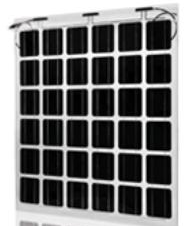
The composite layer is composed of two pieces of glass and the composite solar cell in the middle. Between the cells, there is a series of wires and a parallel connection to collect the lead ends as an integral component called: Double-glazed solar pv module. To
1.2 Composition of double-glass photovoltaic modules
The two pieces of glass of the double-glass photovoltaic module must be toughened safety glass; ②The glass facing the light must be ultra-white glass ③The cell includes: any one of monocrystalline silicon, polycrystalline silicon, and amorphous silicon; ④The composite layer must It is a polyvinyl butyral resin (PVB) composite layer (as required by the National Building Glass Safety Code).
IP67 Connectors solar cable connector PV DC connector For Outdoor Harsh Environments
Solar connector Male And Female Solar Connector for Solar PV System / Solar Power Supply
solar collector, solar array connector, water connector with Tin Plated Copper Contact
Stable Performance solar Compatible Connectors For Connecting Solar Panels
Solar Panel solar Diode Connector IP68 With Tin Plated Copper Contact
Solar Wire Connectors , PPO Insulated Solar Panel Connector Plugs
Fuse Connector IP68 For Outdoor Extreme Environments
Multi Contact 4 Inline Fuse Holder Connector For Photovoltaic System
fuse connector and a terminal fitting, fuse connector block
PPO Insulated Waterproof protection solar connector fuse on connector
