Solar PV technology will become one of the green energy technologies in the future. Solar or photovoltaic (PV) is increasingly used in China. In addition to the rapid development of government-supported photovoltaic power plants, private investors are also actively building plants and planning to put into production solar modules sold around the world. For the time being, however, many countries are still at the learning stage. There is no doubt that in order to make the best profits, companies in the industry need to learn from countries and companies that have years of experience in solar applications.
The construction of economical and efficient for-profit photovoltaic power plants represents the most important goal and core competitiveness of all solar manufacturers. In fact, profitability depends not only on the efficiency or high performance of the solar module itself, but also on a series of components that appear to be not directly related to the component. However, all these components (such as photovoltaic cables, solar connectors, photovoltaic junction boxes) should be selected in accordance with the long-term investment objectives of the tenderer. The high quality of the selected components can avoid the unprofitable solar system due to high maintenance and maintenance costs.
For example, a wiring system that connects photovoltaic modules to inverters is not usually considered a critical component.
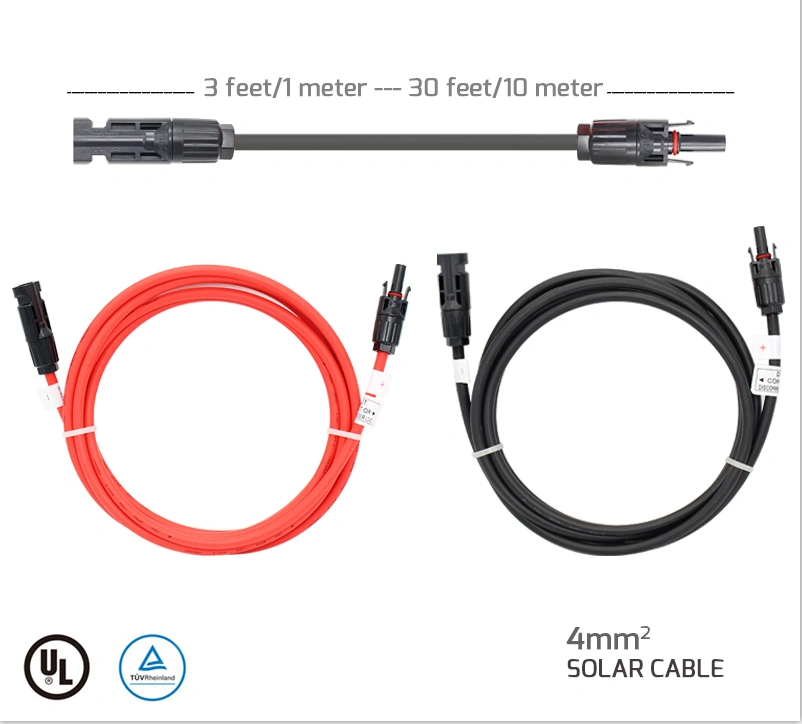
However, failure to use dedicated cables for solar applications will affect the service life of the entire system.
In practice, solar systems are often used in harsh environmental conditions, such as high temperatures and ultraviolet radiation. In Europe, sunny weather will lead to on-site temperatures of solar systems as high as 100°C. At present, we can use a variety of materials have PVC, rubber, TPE and high quality cross-linking materials, Unfortunately, rubber cables with a nominal temperature of 90°C and even PVC cables with a nominal temperature of 70°C are often used outdoors, which obviously has a significant impact on the service life of the system.
environmental stress
As far as photovoltaic applications are concerned, outdoor materials should be based on ultraviolet light, ozone, severe temperature changes and chemical erosion. The use of low-grade materials under this environmental stress will cause the cable sheath to be fragile and even break down the cable insulation layer. All of these situations directly increase the loss of cable system, at the same time, the risk of cable short circuit will also increase, and in the medium to long term, the possibility of fire or human injury is also higher.
Solar cable is a kind of electron beam cross-linked cable with rated temperature of 120 °C. it can withstand bad weather environment and mechanical shock in the equipment to which it belongs. According to the international standard IEC216,RADOX solar cable, the service life of solar cable is 8 times longer than that of rubber cable and 32 times of that of PVC cable in outdoor environment. These cables and components not only have the best weather and rain resistance, UV and ozone corrosion resistance, but also can withstand a wide range of temperature changes (for example, from-40 °C to 125 °C).
In response to the potential dangers caused by high temperatures, manufacturers tend to use double-layer insulated rubber sheathed cables. However, the standard version of such cables is allowed only in environments with a maximum operating temperature of 60 °C. In Europe, however, the temperature that can be measured on the roof is as high as 100 °C.
The rated temperature of the solar cable is 120 °C (20000 hours available). This rating is equivalent to 18 years at 90 °C continuous temperature, and has a longer service life when the temperature is below 90 °C. In general, solar equipment is required to have a useful life of more than 20 to 30 years.
For all the above reasons, it is very necessary to use special solar cables and components in solar energy system.
Anti-mechanical load
In fact, during installation and maintenance, the cable can be wired on the sharp edge of the roof structure, while the cable is subjected to pressure, bending, tension, cross-tensile load and strong impact. If the strength of cable sheath is not enough, the cable insulation will be seriously damaged, which will affect the service life of the whole cable, or lead to short circuit, fire and personnel injury risk and other problems.
The material cross-linked by radiation has high mechanical strength. The cross-linking process has changed the chemical structure of the polymer, and the fusible thermoplastic material has been converted into non-fusible elastomer material. The cross-link radiation has significantly improved the thermal, mechanical and chemical properties of the cable insulation material.
Electric performance
1. When the DC resistance of the finished cable is 20 ℃, the DC resistance of the conductor core is not more than 5.09 Ω / km.
2. The finished cable (20m) was not broken through 5min voltage test (AC 6.5kV or DC 15kV) after soaking in water at (20 ±5) ℃ for 1 h.
3. The long-term DC voltage resistant sample was 5 m long and put into distilled water containing 3% sodium chloride (NaCl) at (85 ±2) ℃ for (240 ±2) h, and the 30cm at both ends was exposed to the surface of the water. DC 0.9kV voltage is added between the wire core and the water (the conductor core is connected to the positive electrode, the water is connected to the negative electrode). After the sample is taken out, the immersion voltage test is carried out. The test voltage is AC 1kV, and no breakdown is required.
4. When the insulation resistance is 20 ℃, the insulation resistance of the finished cable is not less than 1014 cm,. The insulation resistance of the finished cable is not less than 1011 cm at 90 ℃.
5. The surface resistance of the sheath surface resistance of the finished cable sheath should not be less than 109 Ω.
PV cable application range
Widely used in indoor and outdoor solar equipment electrical installation line.
Features: low smoke halogen-free, excellent cold resistance, UV resistance, ozone resistance and climate resistance. Flame retardant, resistance to cuts and penetration. Cable protection level II.
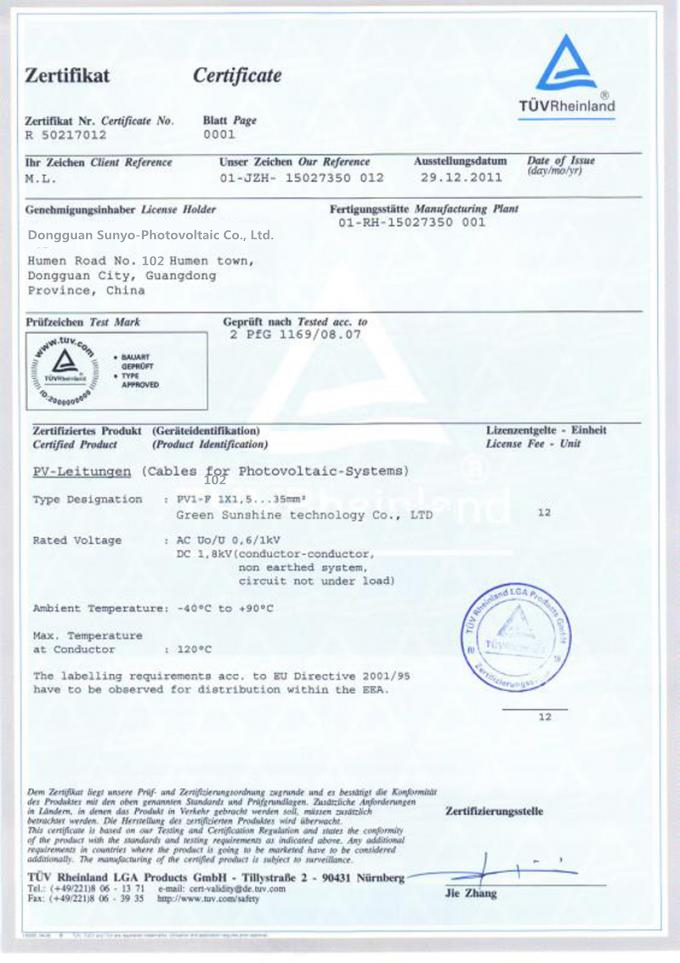
Ambient temperature: -40℃~+90℃;
Maximum temperature of conductor: 120℃ (200℃within 5s allowed);
Rated voltage: AC0.6/1kV 1.8kV
Design life: 25 years
Dongguan Sunyo Photovoltaic Co., Ltd. is committed to the research and production of solar photovoltaic connectors, photovoltaic junction boxes, photovoltaic wires and photovoltaic connection modules. It is widely used in photovoltaic power stations, grid-connected power generation, off-grid power generation, roof system, home power supply system, solar mobile power supply, solar cell phone cells, communication power supply, solar lamps (street lamps, lawn lights, courtyard lights and traffic lights). Solar architecture and other fields, and formed by product research and development, mold design, production to sales of one-stop service, to provide customers with high-quality products, high-quality services.
IP67 Connectors solar cable connector PV DC connector For Outdoor Harsh Environments
Solar connector Male And Female Solar Connector for Solar PV System / Solar Power Supply
solar collector, solar array connector, water connector with Tin Plated Copper Contact
Stable Performance solar Compatible Connectors For Connecting Solar Panels
Solar Panel solar Diode Connector IP68 With Tin Plated Copper Contact
Solar Wire Connectors , PPO Insulated Solar Panel Connector Plugs
Fuse Connector IP68 For Outdoor Extreme Environments
Multi Contact 4 Inline Fuse Holder Connector For Photovoltaic System
fuse connector and a terminal fitting, fuse connector block
PPO Insulated Waterproof protection solar connector fuse on connector
